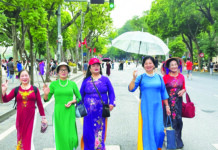
I have been travelling a bit lately – just to Vietnam which is such a wonderful country and as everyone says “the people are just so lovely.” It got me thinking, what is it about the people that make them so lovely? I was thinking it might have been their religion, but as an expat I was talking with said, there are actually a lot of Vietnamese who don’t practise any particular religion (we would call this spirituality in the Western world, where you believe there is something greater than yourself, its just not a religion). So then I was thinking, maybe it is from being downtrodden for so long, with attempts by the Chinese, the French, the Americans to colonise them, it has made them so resilient and determined to make Vietnam into an exceptional country.
Whatever it is, it is working. Vietnam’s tourism sector closed out 2025 with an unprecedented 21.2 million international arrivals, marking a 20.4% surge over 2024. And the wellness sector is certainly growing as well. Wellness tourism is viewed as a key segment in Vietnam that is expanding rapidly. This growth is fuelled by demand for spa retreats, yoga and meditation programs, and wellness resorts. The Vietnamese government is supporting this growth through its national tourism development strategy, which has a vision to establish wellness retreats that integrate health services extending through to 2030.
I have already seen and experienced evidence of this in my travels, attending the Hotlist 2025 event that showcases the best businesses from the hospitality sector in Vietnam, hosted by the Travellive Media Group and supported by The Brand Promise in early 2026. I have also visited some of the top wellness spas and retreats in the country and will be reviewing more of these in The Art of Healing throughout the year.
Artificial Intelligence. It’s well and truly here. How do you feel about it? How often do you use it? What do you use it for? I don’t know about you, but I can see it very quickly infiltrating everything we do. The uptake has been astounding, and the speed of change – hard to fathom. So the least we can do is try to understand it and educate ourselves in the best ways to use it. One thing I know – its great for numbers and computations. Not so good – at all – for journalism. (At time of writing), its interpretation skills were absolutely atrocious.
And what about in the health sector? How is AI being used by the health profession and consumers to find answers to their health issues? In this issue we spoke with Dr Joshua Pate, Health AI Research Lead at the University of Technology Sydney’s Graduate School of Health, and asked him to explain the best way we can use this ‘generative’ technology in health settings, and how it can be manipulated.
Our Feature in this issue is on Ageing, Beauty and Skincare. It was really interesting to learn about the peaks we may experience at different stages in our lives, with respect to psychological functioning, reasoning, and emotional stability. Similarly, quite revealing to peer into the crystal ball that is aesthetic medicine. We include some beauty hacks and safe techniques to achieve positive skincare results without unwanted side affects, and look at how coffee grounds can be reused in simple at-home routines to exfoliate skin, refresh hair and reduce waste.
Mental Health is such a huge topic and one that is certainly not going away. Nearly 1 in 7 people globally (over 1 billion) now live with a mental disorder, with anxiety and depression being the most common. Further, findings from new research by the University of SA has revealed that 45% of young Australians are now on antidepressants and are staying on them for longer.
Our article on Telepsychology describes what it is, how it provides flexibility and removes stigma attached to seeing clinicians in-person, and how it is being incorporated into the Australian mental health system to reach more people at-scale. This is a setting where AI has huge potential to reach more people, plus it is more accessible than an in-person appointment, and it can be personalised. With an estimated 85% of people with mental health conditions not receiving treatment, AI tools like chatbots, virtual therapists, and predictive analytics are emerging as critical adjuncts to traditional care, and we are looking forward to researching these areas further in future issues of The Art of Healing.
So that’s it from me for this issue. I hope you enjoy your reading and get some good, strong, positive outcomes you can incorporate into your day-to-day lifestyle so you can be more healthy and happy for yourself and those around you.
CATE MERCER
Editor/Publisher
The Art of Healing
This Editor’s Note appeared in Vol 1 Issue 94 of The Art of Healing.