
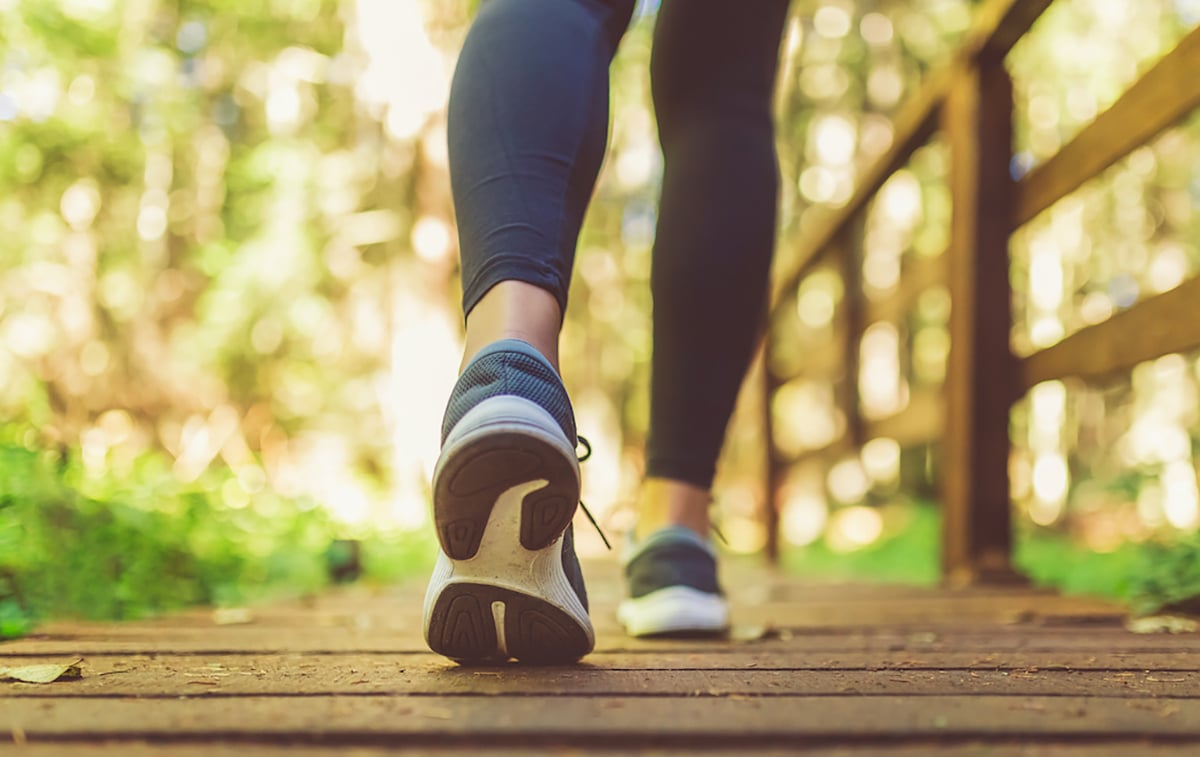
Restorative fitness has grown in popularity over the past few years – especially when it comes to walking.
Most people don’t realise walking is considered a weight-bearing exercise, according to Steve Stonehouse, a running and walking coach. Given that walking is usually grouped in the cardio category, this adds to the ever-growing list of serious benefits you get from it – yes, even from just walking a mile a day.
“Walking is a weight-bearing exercise. Even if you’re not holding weights or you’ve got ankle weights on, it’s a weight-bearing exercise,” Stonehouse says. “You’re getting all of the cardio and respiratory benefits, but your muscles are getting benefits too, because they’re having to carry your weight around.”
Below are some proven health benefits of walking and how to up your walking challenge.
THE BENEFITS OF WALKING A MILE A DAY
Strengthens Muscles
While walking isn’t the same as strength training, you still get some strength-building benefits from engaging muscles throughout your body as you walk. So what muscles does walking work?
“We think of walking as primarily cardiovascular training – which it is. But walking also works our entire lower body, including legs, calves, and hips,” Schemper says.
And depending on the terrain you’re walking on, you can tap into specific muscle zones.
“Walking up hills or on an incline really targets our glutes and hamstrings,” she adds. “And walking [in general] requires significant core stabilisation, so your abdominal muscles are also engaging with every step.”
Further, because walking keeps the core engaged, the mile-a-day benefits might include improved posture, too.
Walking a mile a day will engage all of your lower-body muscles as well as your core and arms if your form is good.
Boosts Bone Health
Your bones respond to your movement, especially if that movement is weight-bearing such as when you walk a mile a day.
According to the National Institute of Arthritis and Musculoskeletal and Skin Diseases, your bone tissue responds and grows stronger when you exercise.
Prioritising exercise (such as walking a mile a day) can also help you prevent bone loss as you age.
Sets a Healthy Routine
Walking can be a great way to get some fresh air and time for yourself.
Aside from the physical effects of daily walks, this habit gives you time to think, listen to music or a podcast, or catch up with a friend.
There’s also something to be said about setting a goal and sticking to walking a mile a day because it builds consistency and routine.
“I think there’s value in routines and the discipline that requires, even aside from the physical benefits,” Stonehouse says.
Improves Cardiorespiratory Health
Walking is good for your heart.
Research shows that incremental increases in daily step counts, up to 10,000 steps per day, were linked to a substantially lower risk for a major adverse cardiovascular event in adults living with hypertension.
Any time you move, your body has to “push blood and fluids and everything through your system, more than it would if you weren’t walking,” notes Stonehouse. That push gives your heart a workout and your body a boost.
Benefits of Walking 3 Miles a Day
What if you want to up the ante and log some extra miles on your walks? “Good idea! A three-mile walk is an ideal workout because it gives you just enough time to throw in some variety (such as by doing intervals) while still keeping your workout attainable and doable,” according to Stonehouse.
You can make your workout simple by setting the first mile as your warm-up, the second mile as your “working” mile, where you challenge yourself by going up a hill or taking a different path, and the final mile as your cooldown.
How to Make Walking a Mile a Day More Challenging
Here are some ideas for making any walk, whether it’s one, three, five, or more miles, into even more of a beneficial workout.
Take a Route With Hills
If you can find an area with more hills or something other than a flat road, take your walk there to mix it up.
Challenge Yourself With Intervals
During your “working” mile, alternate between walking slowly for one minute and quickly for one minute.
Try 5-Minute Blocks
Push the pace for one minute, then do four minutes at a normal tempo. Repeat these five-minute blocks until you’ve gone three miles or reached your timed goal.
Change Up the Scenery
Do your three miles hiking a trail for a challenge and an extra dose of calm.
Tips for Preventing Walking Injuries
One of the most common issues Stonehouse sees in the clients he coaches is pain and issues that result from overdoing exercise when you haven’t been active. Keep in mind that even one mile is something you should do at your own pace and work your way up to if you’ve been sidelined due to an injury or sickness.
Finally, the shoes that you wear while walking are also important because your feet need the proper support to carry you through each step. Don’t forget to replace your sneakers about every six months, depending on how much you walk.
Tips for Good Walking Form
To reap all of the benefits of exercise and to make sure you’re using the correct muscles, you have to have good form. When your form gets wonky, injuries can occur.
Upper-Body Form Tips
Stonehouse and Schemper emphasise the importance of keeping your upper body in check when you walk, especially if you have a sedentary job or lifestyle, which can make us tight and hunched.
“Walking helps improve our upper body and posture and helps combat general tension we get from sitting at our desks and in our cars,” Schemper says.
In order to reap that reward though, you have to walk with your shoulders and hips stacked squarely over each other, and Stonehouse says to keep your arms moving.
“Sometimes when people get tired, their arms move less,” he says. To make sure they swing, he suggests keeping your arms a bit loose and letting them follow your leg motion. But also be mindful of not crossing them too much. “Make sure that the arms are swinging, but I never want the arms crossing the midline of the body.”
Heel Strike
You’ve probably heard the term “heel strike” applied to runners more than walkers, but, according to Stonehouse, it’s important for both groups to pay attention to.
For walkers, you want a “good heel strike on the outside of your heel. Then you will naturally roll over to your midfoot and then off on your big toe.”
SOURCE: Everyday Health